

Overview

KompiPay · Fintech · Full Stack

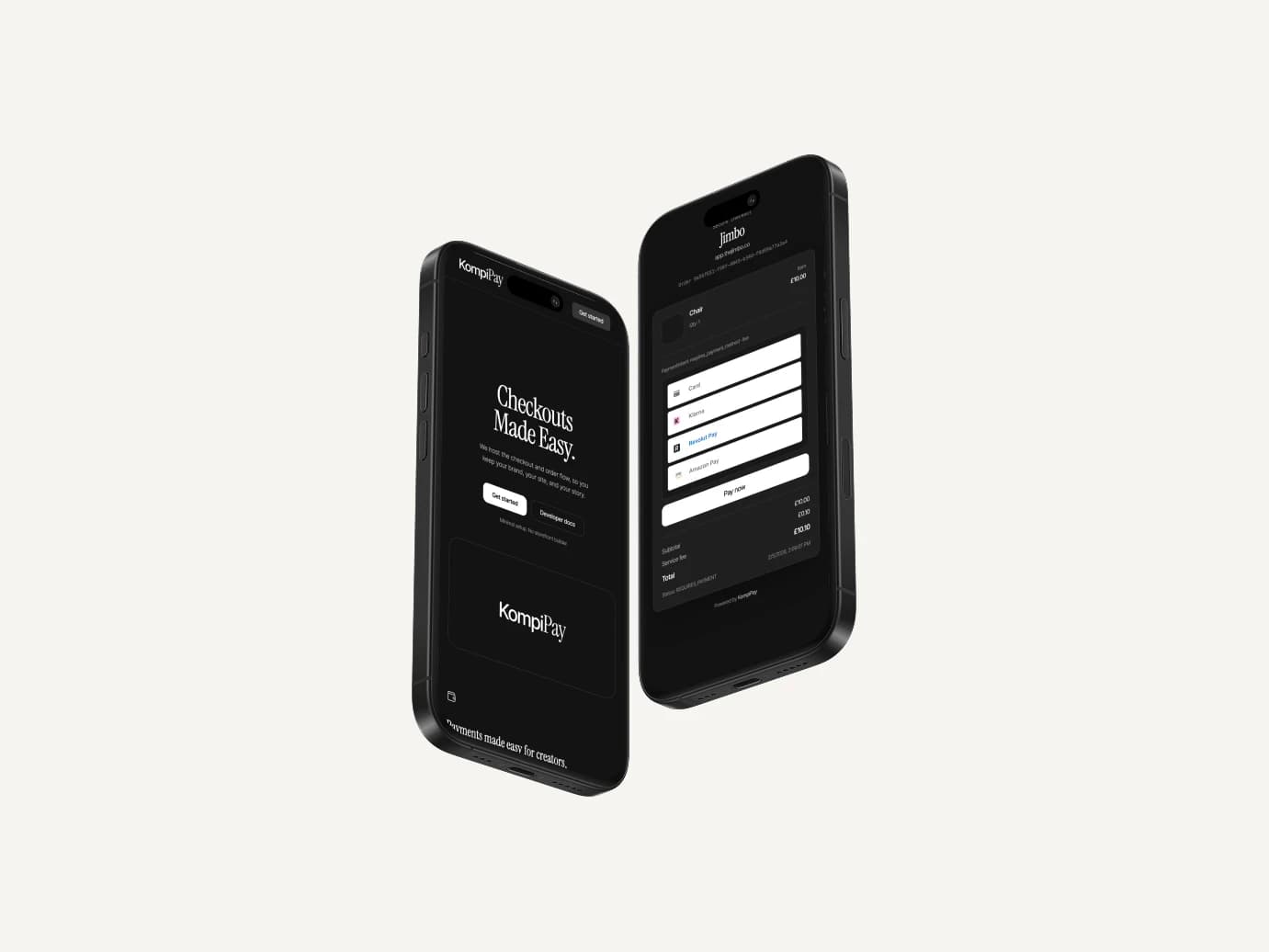
KompiPay is a payments platform for businesses that want to take payments on their own website without running Shopify (or building payments infrastructure themselves). It provides a hosted checkout + order system that can be added to any custom site, powered by Stripe behind the scenes.

The wedge is simple: Stripe-grade payments, with a productised checkout experience — brand-led, fast to integrate, and lightweight to operate.

Product Design · UI/UX · Branding · Web Design · Product Build
KompiPay visual 1
KompiPay visual 2
KompiPay visual 3
KompiPay visual 4
Deep dive01 / 10
01

The problem

A lot of independent sellers want a custom, brand-led website — but still need checkout reliability, security, and operational basics. Shopify can feel too heavy and opinionated. Stripe is powerful, but too low-level to implement quickly without engineering time. KompiPay sits in the middle: a productised checkout that feels native to the merchant, while remaining Stripe-powered under the hood.


KompiPay — Problem framing
02

Strategic framing

I framed KompiPay around a simple category: payment moments. Not a storefront builder, not a marketplace, not a wallet — just a clean way to request and complete payments online, quietly and brand-respectfully. The north star was: “should feel like early PayPal” — reliable infrastructure, minimal surface area, and a checkout experience that doesn’t hijack the merchant’s brand.

KompiPay — Strategic framing
03

Hosted checkout as a product

The core UX decision was to make checkout hosted — not embedded spaghetti in every merchant codebase. Hosted checkout gives KompiPay control over reliability, compliance, and consistency, while still allowing the merchant to keep the brand story on their site. The result is a checkout flow that is fast to adopt and safe to run, without becoming a theme engine or a storefront platform.

KompiPay — Hosted checkout
04

Buyer flow (v1)

The buyer journey is intentionally minimal: Buyer clicks Buy → merchant creates an order → KompiPay returns a checkout URL → buyer pays on hosted checkout → Stripe confirms via webhooks → KompiPay marks the order paid → confirmation + success page. Every step is designed to reduce failure modes: clear state transitions, explicit outcomes, and a clean success surface that feels like the merchant — not like a generic payment processor.

KompiPay — Buyer flow
05

Merchant ops (lightweight dashboard)

Merchants don’t need a full back-office to sell a few high-value products — they need clarity and control. KompiPay’s operational layer focuses on the essentials: orders, payment status, events/logs, basic settings, and the ability to troubleshoot without calling an engineer. The dashboard is designed like a control panel, not an admin maze: calm hierarchy, fast scanning, and clear states.

KompiPay — Merchant operations
06

Integration options (fast path + SDK)

KompiPay supports two integration paths: 1) A fast “payment link button” approach for simple sites — create an order, redirect to checkout. 2) A tiny JS SDK (`window.KompiPay.checkout(...)`) for sites that want control without framework lock-in. This is the adoption strategy: reduce integration friction to near-zero, while keeping the platform extensible for richer use cases later.

KompiPay — Integration options
07

Reliability and safety

Payments products win on trust. I designed KompiPay to behave like infrastructure: predictable state machines, robust webhook handling, and clear failure recovery paths. The goal isn’t “cool features” — it’s to make checkout feel inevitable: buyers trust it, merchants don’t worry about it, and edge cases don’t silently break the business.

KompiPay — Reliability and safety
08

System architecture

KompiPay is built as a clean pipeline: merchant order creation → checkout session creation → Stripe payment intent → webhook confirmation → order state transition → receipts and confirmations. The architecture deliberately separates public checkout surfaces, merchant APIs, and internal order logic, so the product can scale in capability without increasing fragility. It’s a payments system designed to stay boring — stable, auditable, and easy to reason about.

Actors
Merchant Tools
Checkout + Payments
Connect + Distribution
Infrastructure
MerchantDashboard / Onboard
CustomerCheckout / Pay
PlatformFindaly / External
DeveloperSDK / API / Docs
Onboarding WizardCreate → Connect → Products
Merchant DashboardProducts · Orders · Settings
Catalog EngineCSV · Feed · Sync
API KeysPublishable · Secret
Checkout SessionHosted · Embed · SDK
Payment IntentCreate · Confirm · Capture
Order MachineState · Transitions
Stripe ConnectOnboard · Callback · Status
WebhooksStripe → KompiPay
Embed LayerSDK · iframe · API
v2 APIPayments · Sellers
Prisma / DBMerchants · Orders · Products
NextAuthSessions · Accounts
Event LogAudit Trail
Rate LimitAPI Protection
Data flow
Payment flow
Connect / Stripe
Fallback
09

Business model

KompiPay monetises as a platform, not just a processor: a monthly subscription plus a small platform transaction fee, while Stripe processing fees remain separate. This aligns incentives: KompiPay is paid to deliver operational value and reliability over time, not to extract margin from the payment rails.

KompiPay — Monetisation model
10

Outcome

KompiPay shipped as a real product — not a Stripe wrapper. A hosted checkout with brand-respecting UI, a simple merchant operational layer, and a low-friction integration story. It gives independent merchants a credible alternative to Shopify when they want a custom site, while still getting Stripe-grade reliability without Stripe-level complexity.

KompiPay — Outcome
Next project
Findaly cover

Founder · Built · Launched · 2025

Findaly·Maritime Platform