Overview

HomeMgmt · Home Services OS

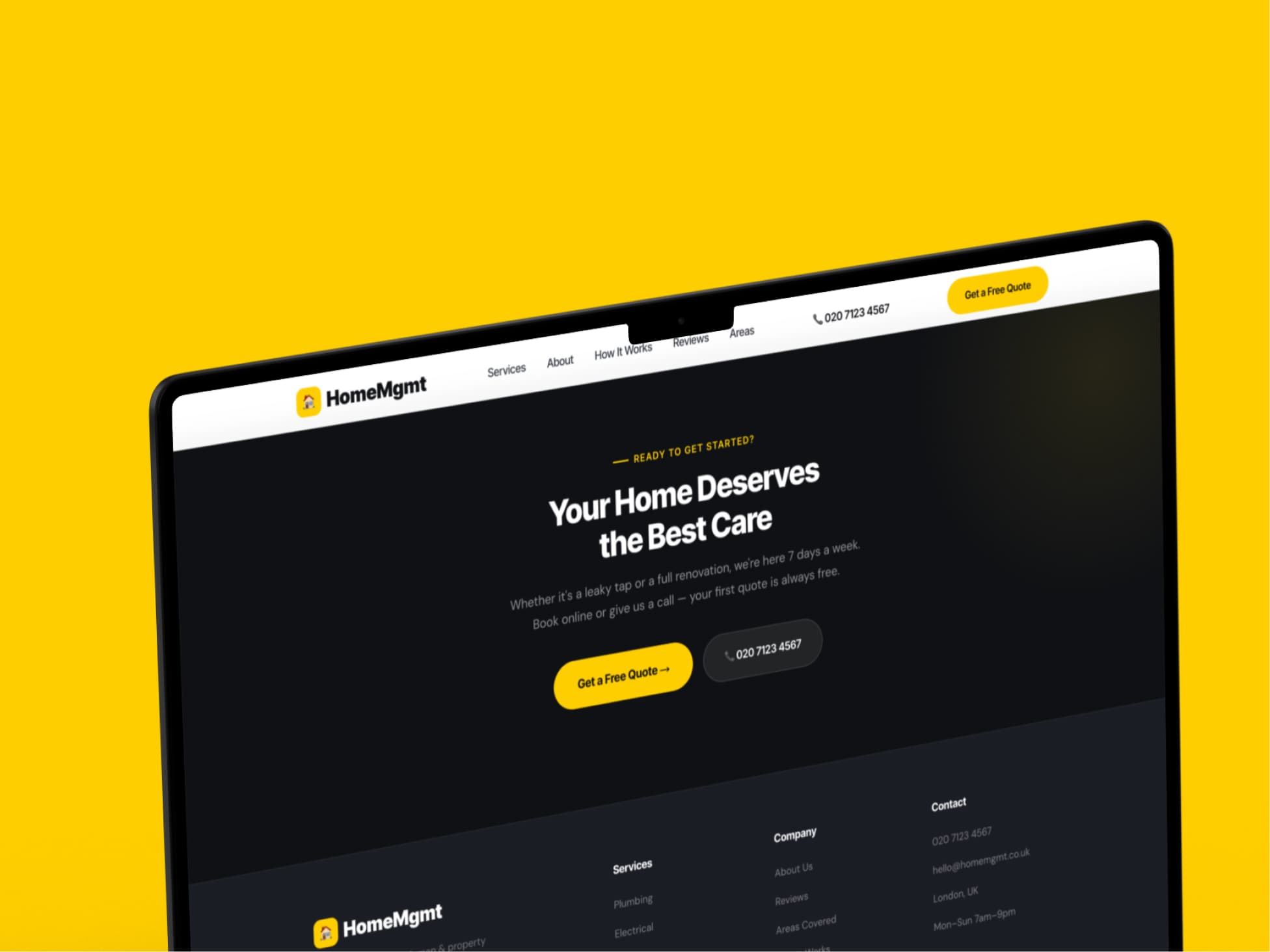
HomeMgmt is a modern operating layer for a multi-trade home services business serving Greater London and Kent. It solves the real bottleneck in the category: not getting traffic, but turning messy homeowner intent into structured, quoteable work — and giving the operator a lightweight internal system to manage cases end-to-end.

Instead of a brochure and an inbox, HomeMgmt functions as a two-sided workflow: a guided project intake for customers, and an admin dashboard for the operator to triage leads, flag issues, assign tasks, and structure payments into stages.

Product Strategy · UX/UI · Workflow Design · Admin Systems · Payment Stages · API Architecture
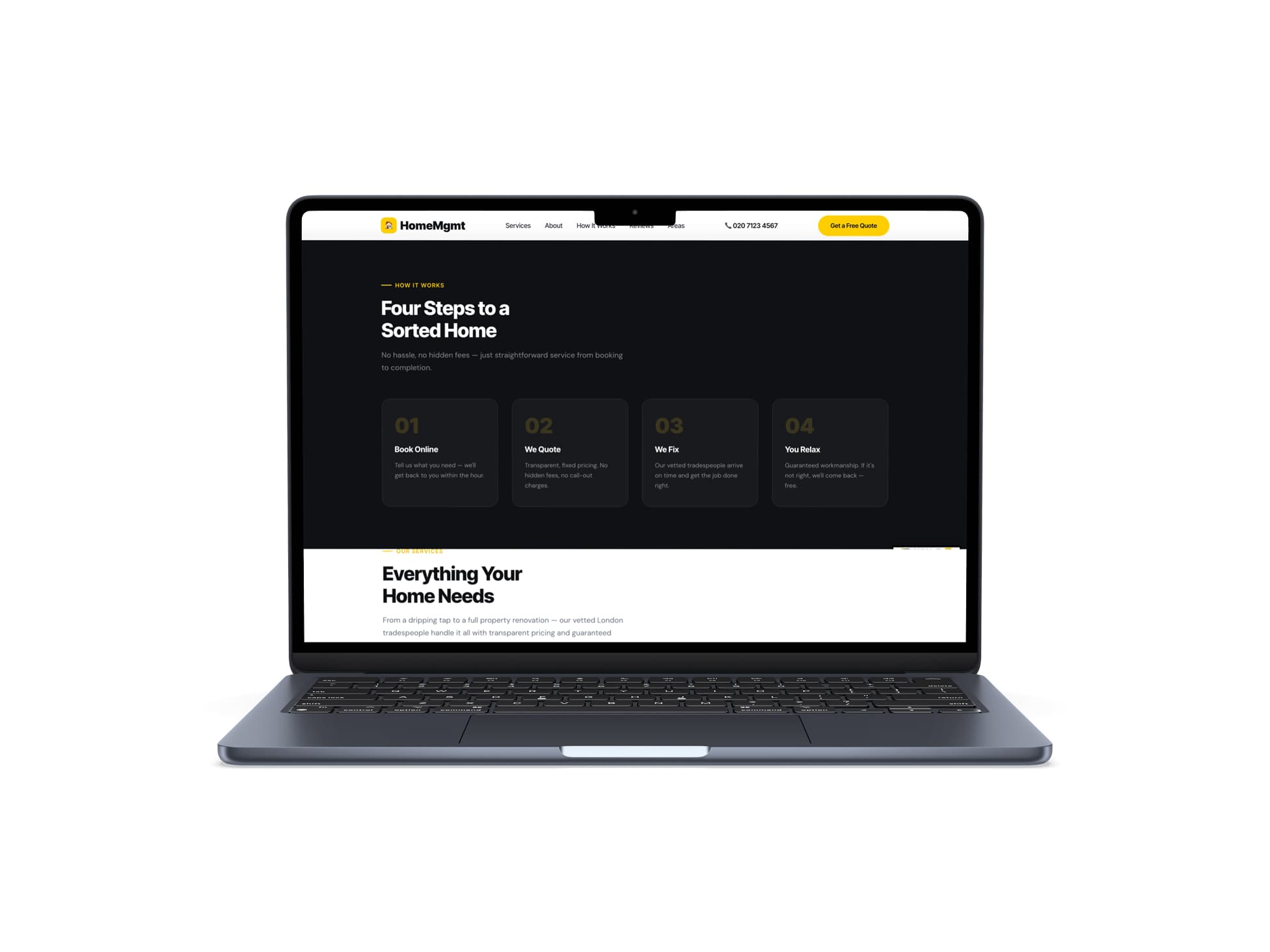
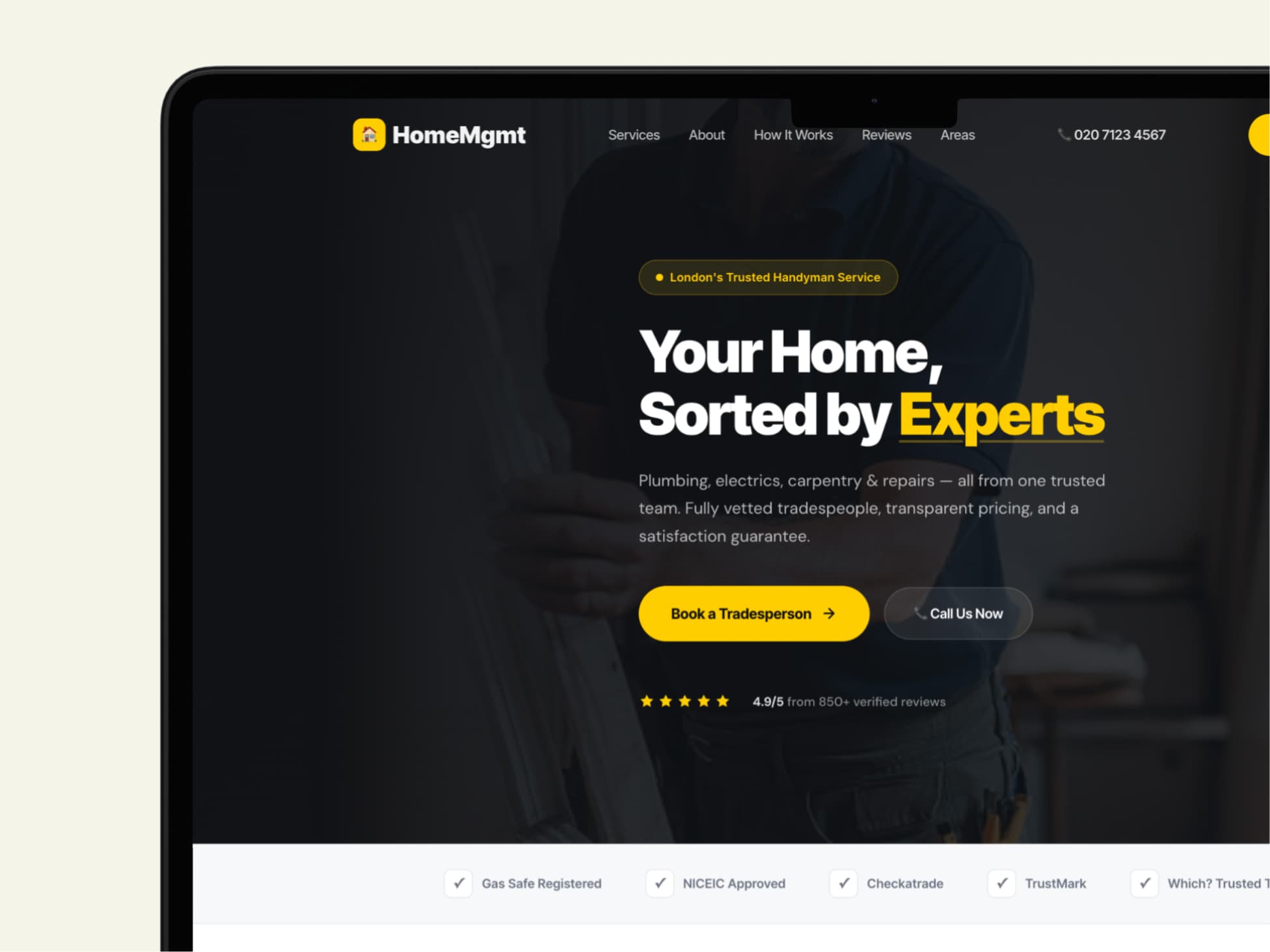
HomeMgmt visual 1
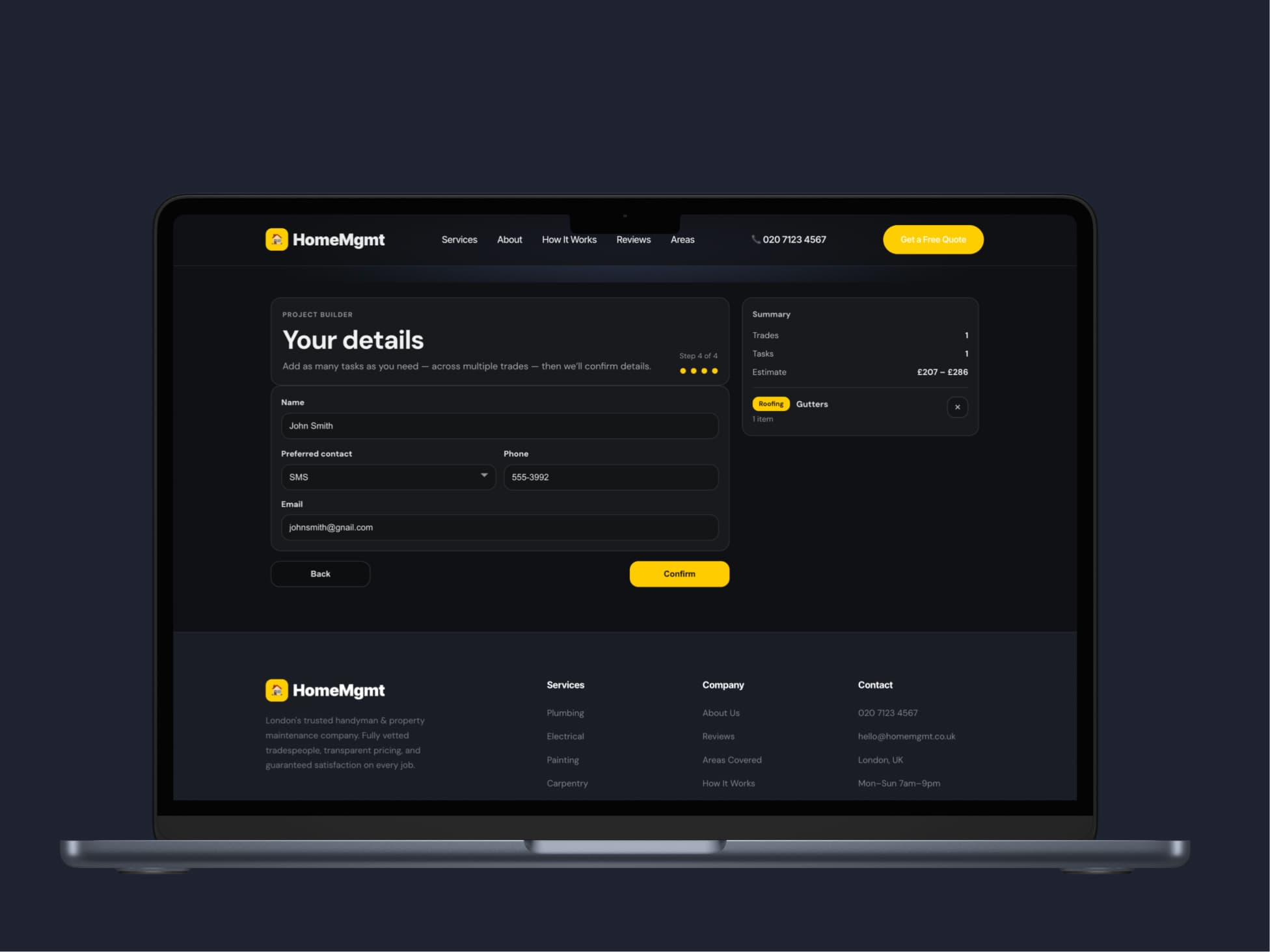
HomeMgmt visual 2
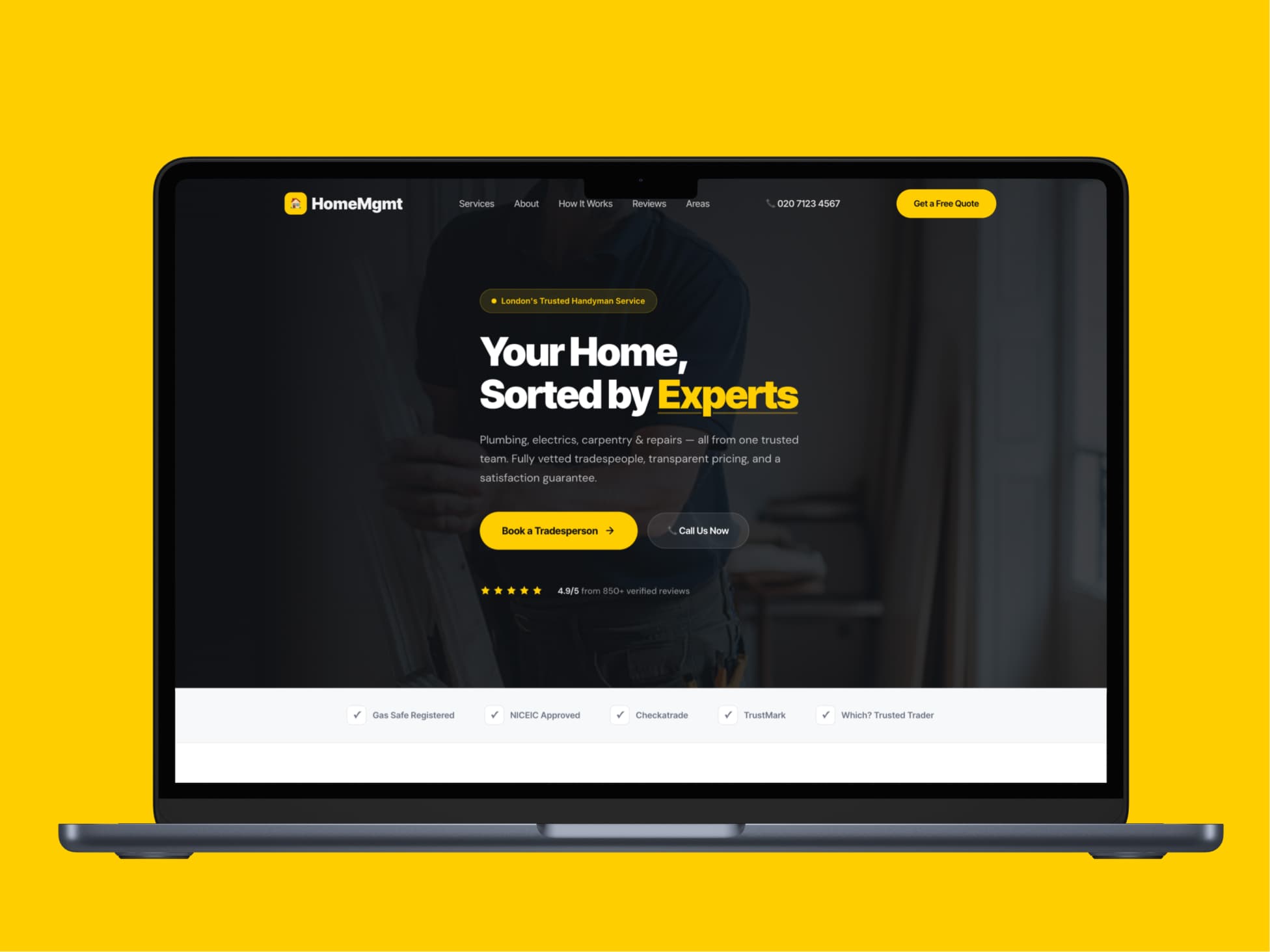
HomeMgmt visual 3
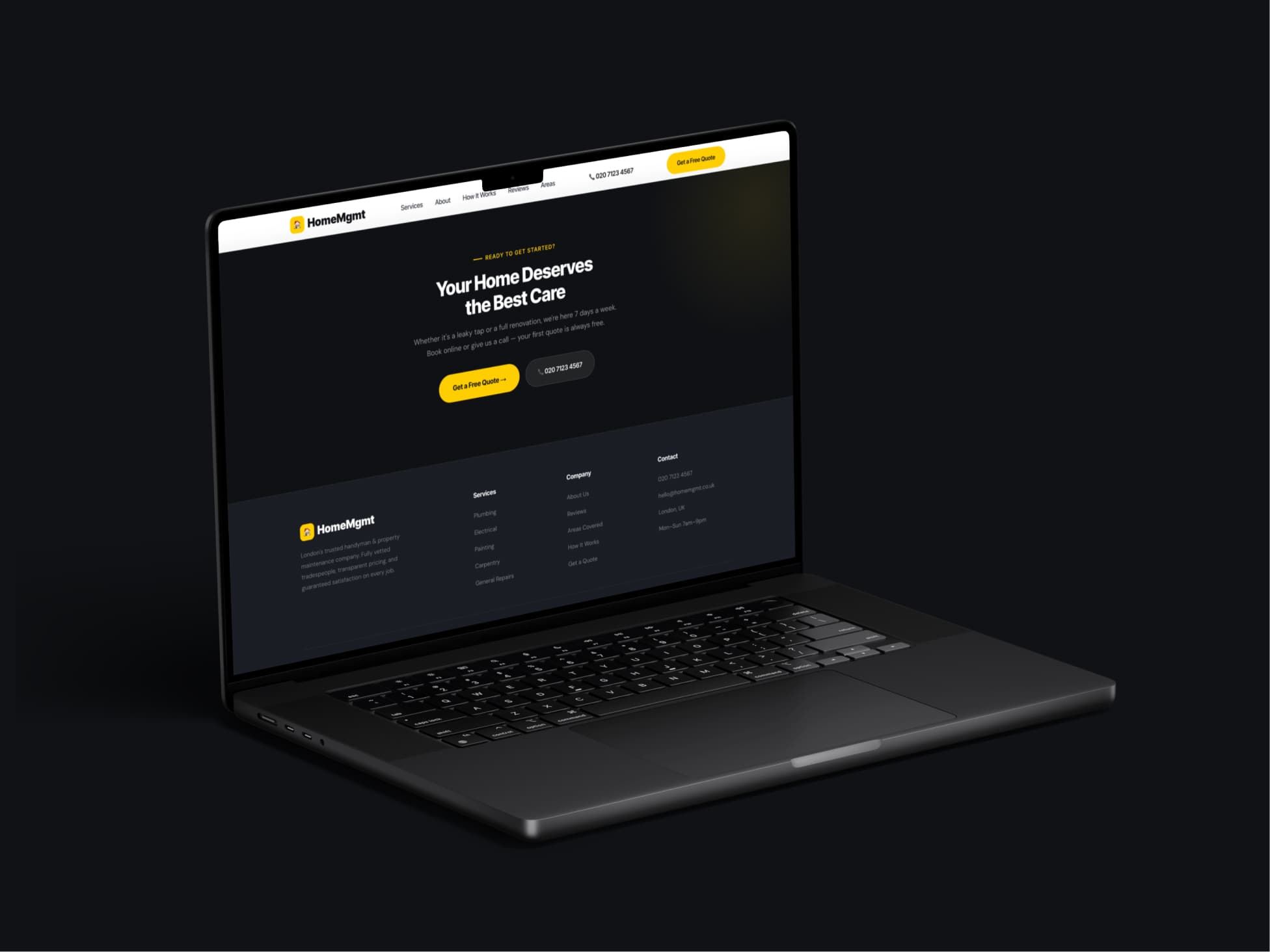
HomeMgmt visual 4
Deep dive01 / 12
01

The market gap

Home services sits in a neglected middle where existing solutions don't fit. Websites are optimised for contact, not clarity — producing low-quality leads and heavy back-and-forth. Marketplaces commoditise work and damage margins. Field-service SaaS is too heavy for small operators. What's missing is a first-party, branded operating system that's simple enough for a small team, structured enough to reduce ambiguity, credible enough to build customer trust, and extensible enough to evolve over time.
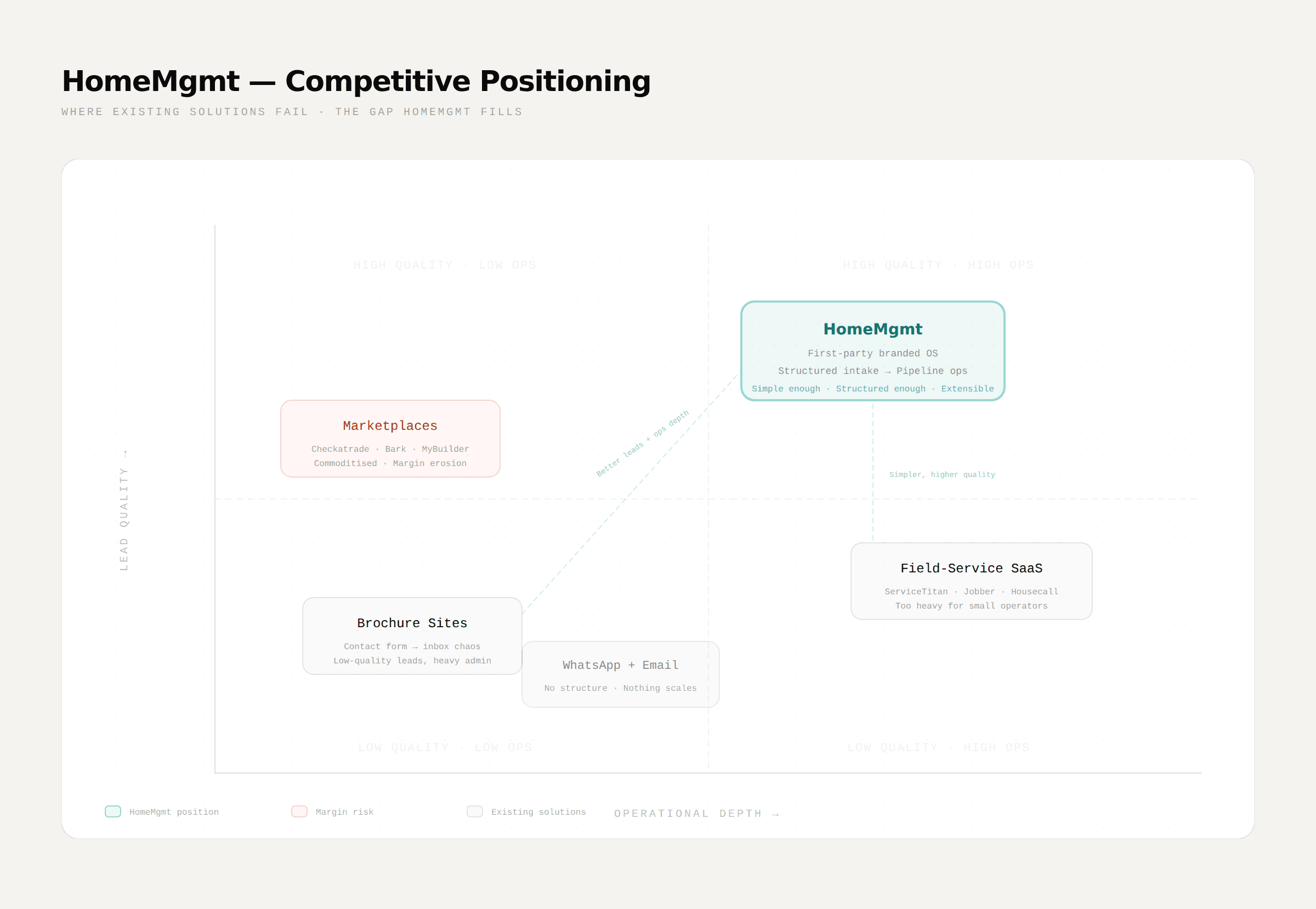
HomeMgmt — Market gap positioning
02

Designing around uncertainty

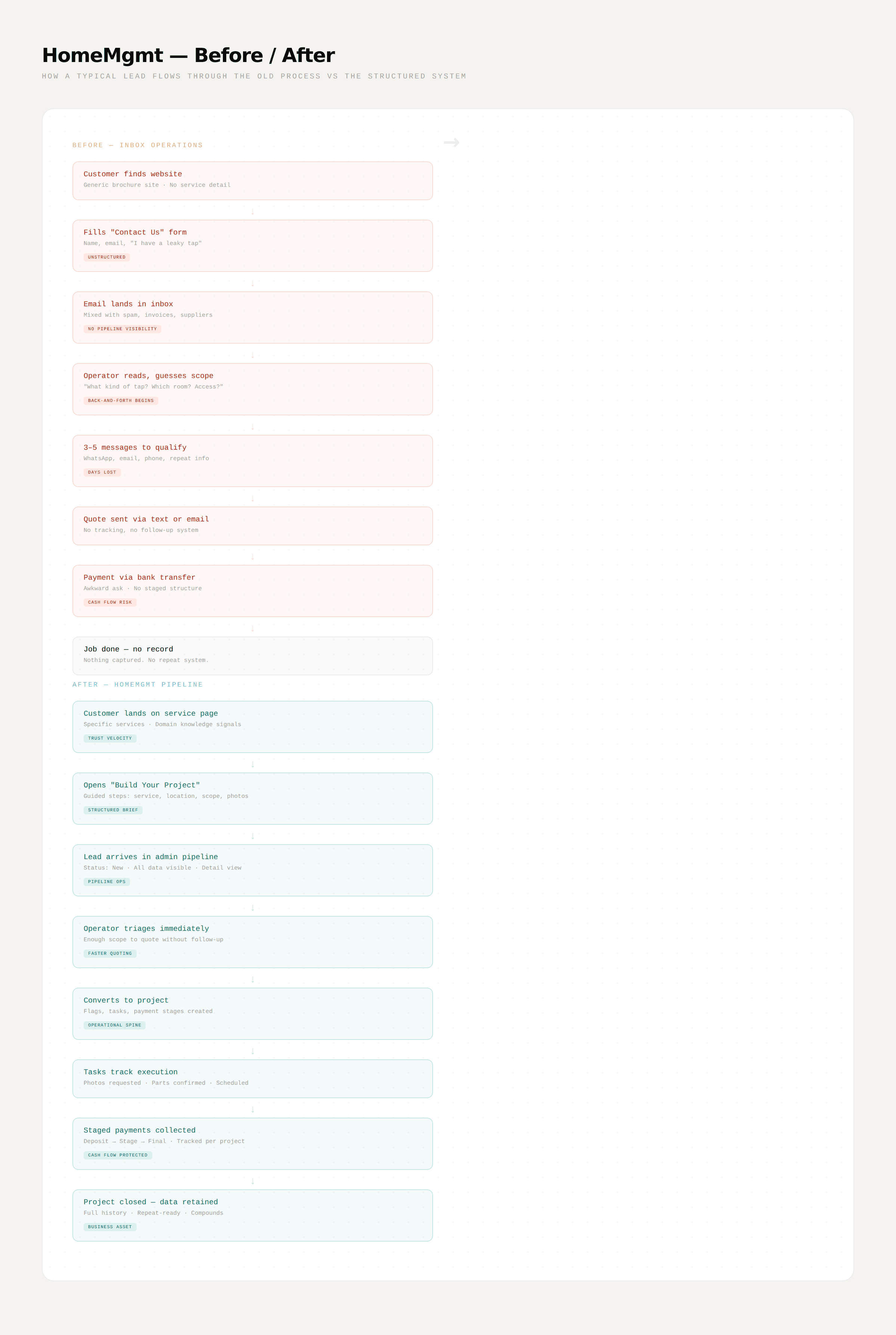
Home services isn't a clean checkout flow — it's ambiguous, emotional, and contextual. Two 'leaky tap' requests can be wildly different jobs. Speed is the deciding advantage, but speed is impossible when every lead arrives unstructured. I designed the entire system around this constraint: capture better inputs, reduce uncertainty, increase trust velocity, and operationalise follow-through. The architecture respects the messiness rather than pretending it doesn't exist.

HomeMgmt — Before/after and uncertainty framing
03

Build Your Project

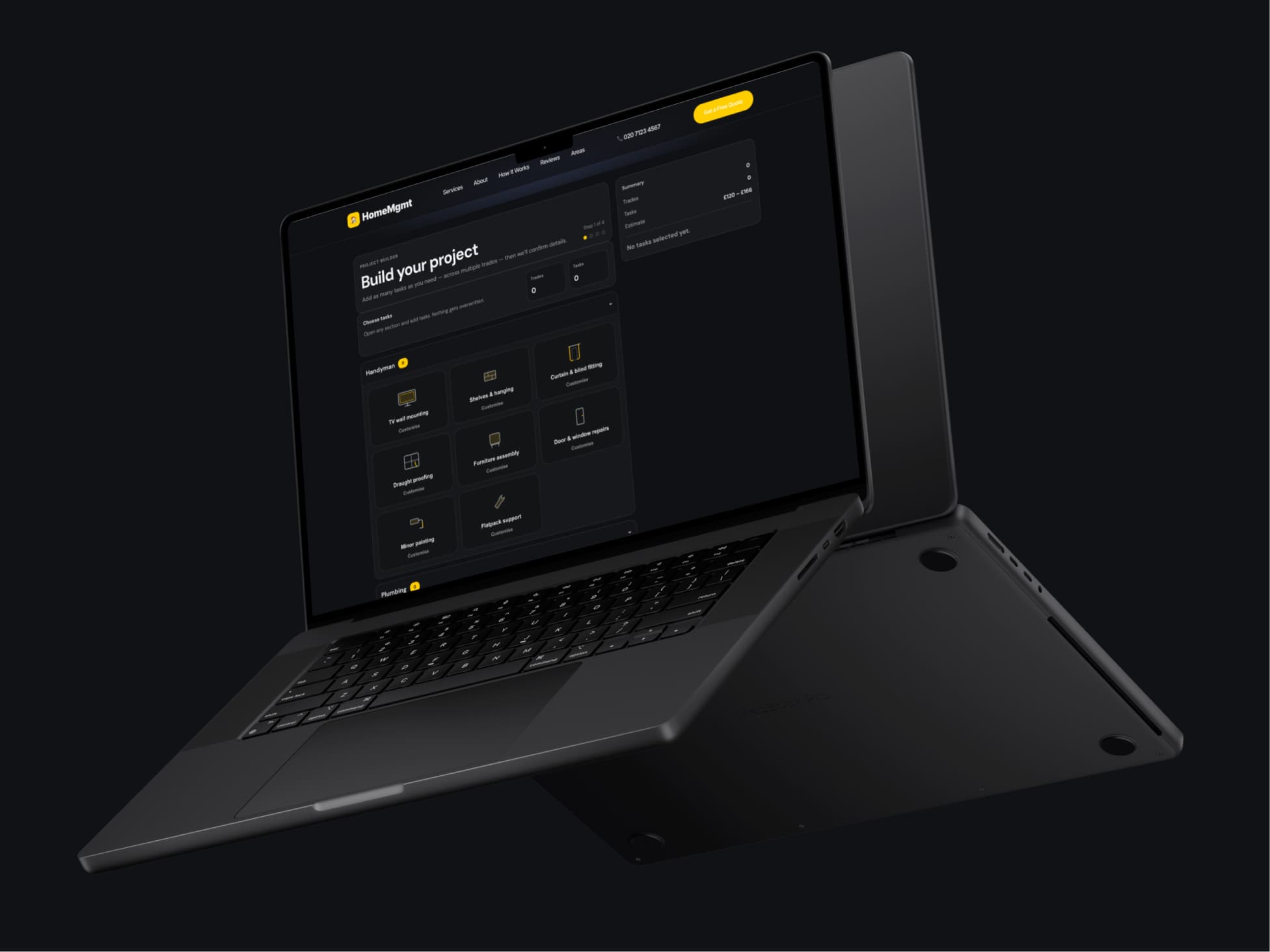
The customer-facing intake isn't a contact form — it's a dedicated project-builder that guides homeowners through a structured submission. Backed by an API route with helpers like postcode lookup to reduce friction, the flow captures the minimum viable scope needed to quote. It reduces form fatigue while producing a usable brief. Better leads, faster quoting, fewer messages, higher close rate. That's the conversion wedge.

HomeMgmt — Build Your Project intake
04

Trust as the core product

Homeowners aren't buying a service category — they're buying reassurance and competence. The intake experience is designed to signal professionalism before a single message is exchanged. Structured steps, clear progress, specific questions that show domain knowledge. By the time a customer submits, they already feel like they're working with a business that knows what it's doing. Structure is the trust signal.

HomeMgmt — Trust velocity design
05

Admin pipeline

Most service businesses don't fail at marketing — they fail at operational throughput once leads arrive. HomeMgmt treats internal triage as a first-class product surface. Dedicated sections for leads management and project management give the operator pipeline visibility instead of inbox chaos. Each lead and project has a clear status, a detail view, and structured data that supports fast decision-making.

HomeMgmt — Admin pipeline
06

Flags and issues workflow

Inside the project system, I designed a deliberate pattern: identify problems, track them, resolve them with intent. Project flags surface missing information, risks, and blockers. An approval route lets the operator explicitly clear issues so the case can progress. This makes hidden work visible and therefore manageable — senior product thinking applied to a messy industry where most competitors just have a to-do list.

HomeMgmt — Flags and issues workflow
07

Task system

Projects support structured tasks that turn each job from a message thread into a plan: request photos, confirm availability, confirm parts required, book a time slot, schedule a revisit. This is where HomeMgmt starts behaving like a lightweight service OS — repeatable execution, fewer dropped balls, clearer handoffs. The task model is simple by design, because complexity kills adoption in small teams.

HomeMgmt — Task management system
08

Payment stages

Instead of one awkward payment moment, HomeMgmt supports staged payments: deposit, stage payments for multi-visit work, and final payment at completion. This reduces customer commitment anxiety, protects operator cashflow, supports larger jobs without negotiation chaos, and gives every project a clear progression arc. It's not a nice-to-have — it's a conversion and risk-management mechanism that directly affects whether bigger jobs get started.

HomeMgmt — Payment stages UX
09

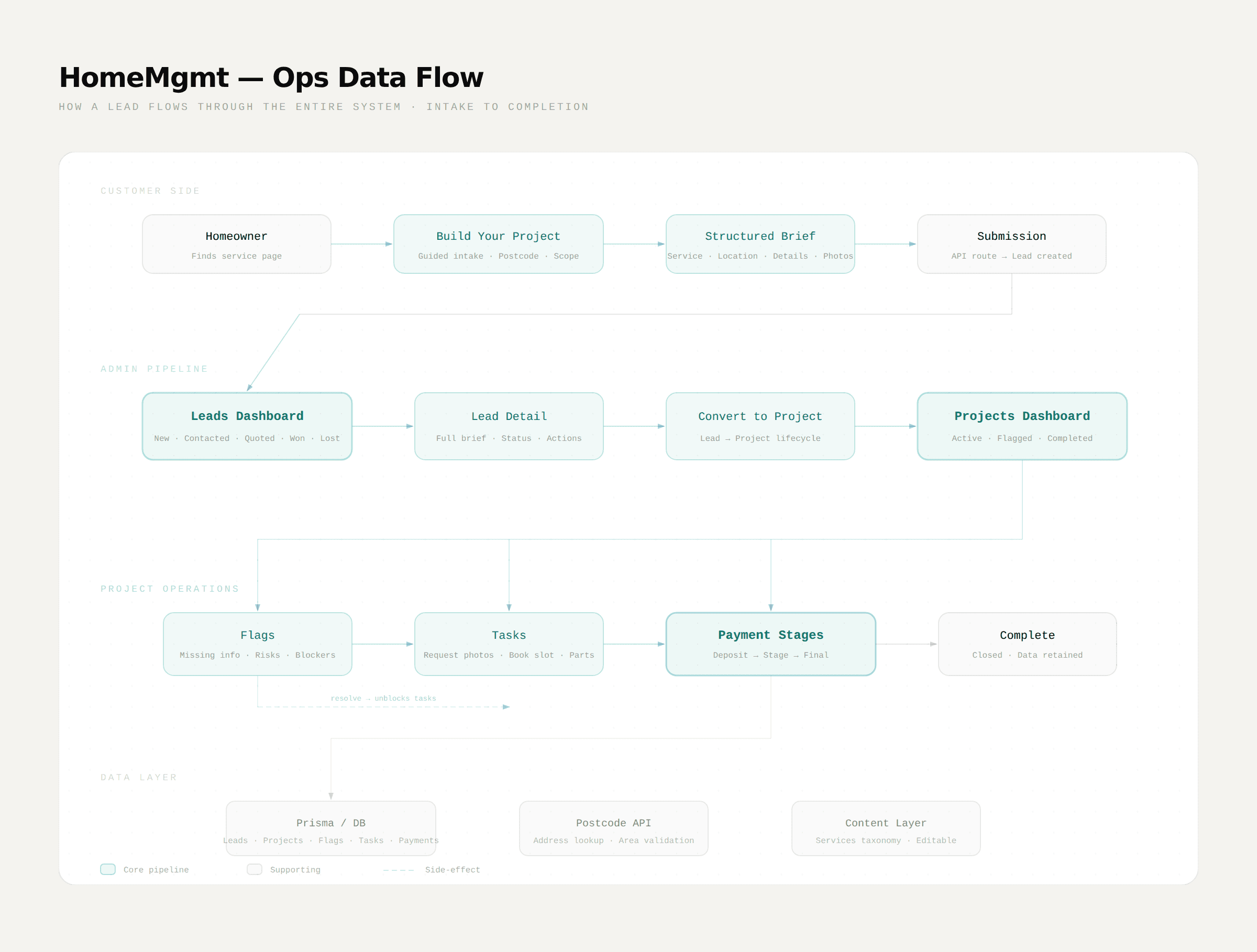
Ops workflow as the real product

Admin triage, flags, tasks, and payment stages are the differentiator — not the marketing site. Most competitors stop at 'contact us'. HomeMgmt carries the job forward from first enquiry through to final payment. That operational layer is what turns a handyman business into a service brand that can grow. The design investment is in the parts the customer never sees, because that's where the leverage lives.

HomeMgmt — Ops workflow data flow
10

System architecture

HomeMgmt is built as a two-sided workflow: customer intake creates structured project data, which becomes the backbone for internal triage, flags, tasks, and staged payments. The architecture separates customer capture from operator execution so the system stays usable for a small team — while still being extensible into scheduling, messaging, quoting templates, and automation.

Actors
Customer Layer — Build Your Project
Admin Layer — Operator Pipeline
Project Operations
Infrastructure
HomeownerNeeds a service
OperatorTriages · Manages · Delivers
VisitorBrowses · Converts
Homepage v3Services · Trust · Process · CTA
Build Your ProjectGuided intake · Steps · Validation
Postcode LookupArea validation · Autofill
Content Layerhome-services.ts · Taxonomy
How It WorksProcess explainer page
Leads DashboardNew · Contacted · Quoted · Won · Lost
Lead DetailFull brief · Status · Actions
Convert to ProjectLead → Project lifecycle
Projects DashboardActive · Flagged · Completed
Project DashboardProjectDashboardClient
FlagsMissing info · Risks · Blockers
TasksPhotos · Parts · Book · Revisit
Payment StagesDeposit → Stage → Final
CompleteClosed · Data retained
Prisma / PostgresLeads · Projects · Flags · Tasks · Stages
postcodes.ioExternal address API
VercelNext.js · Edge · Deploys
MiddlewareAuth · Admin guard
Pipeline flow
Project ops
Data flow
Resolve loop
11

Scalable foundation

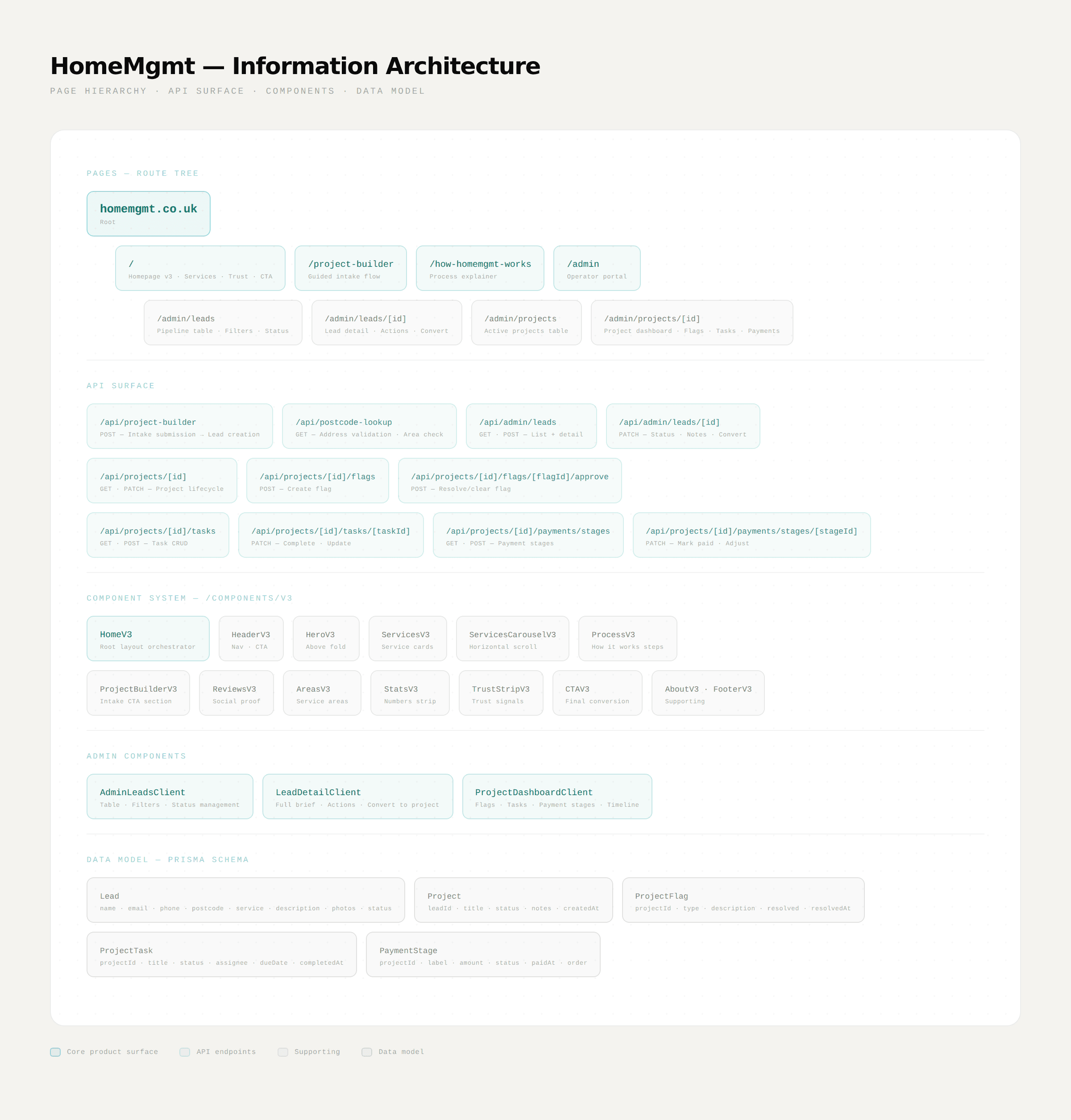
Under the hood, the build uses a modular component system for fast iteration, a service content layer to keep taxonomy editable, and a formalised data model for leads, projects, and operational objects. Projects flow into flags, flags flow into tasks, tasks flow into payments. That's a clean spine for future layers: scheduling, messaging, quoting templates, contractor assignment, recurring maintenance. The product is designed to compound.

HomeMgmt — Information architecture and scalable foundation
12

Outcome

HomeMgmt shipped as a working two-sided operating system — not a brochure site with a contact form. Customer intake consistently produces quoteable briefs. Admins triage work using flags and tasks instead of WhatsApp threads. Payment stages reduce drop-off on larger jobs. The business moved from inbox operations to pipeline operations. One product replacing the entire gap between 'I need a handyman' and 'the job is done and paid for'.

HomeMgmt — Outcome
Next project
FCKOFFEE cover

Brand Designer · Founder · 2024

FCKOFFEE·Brand Identity